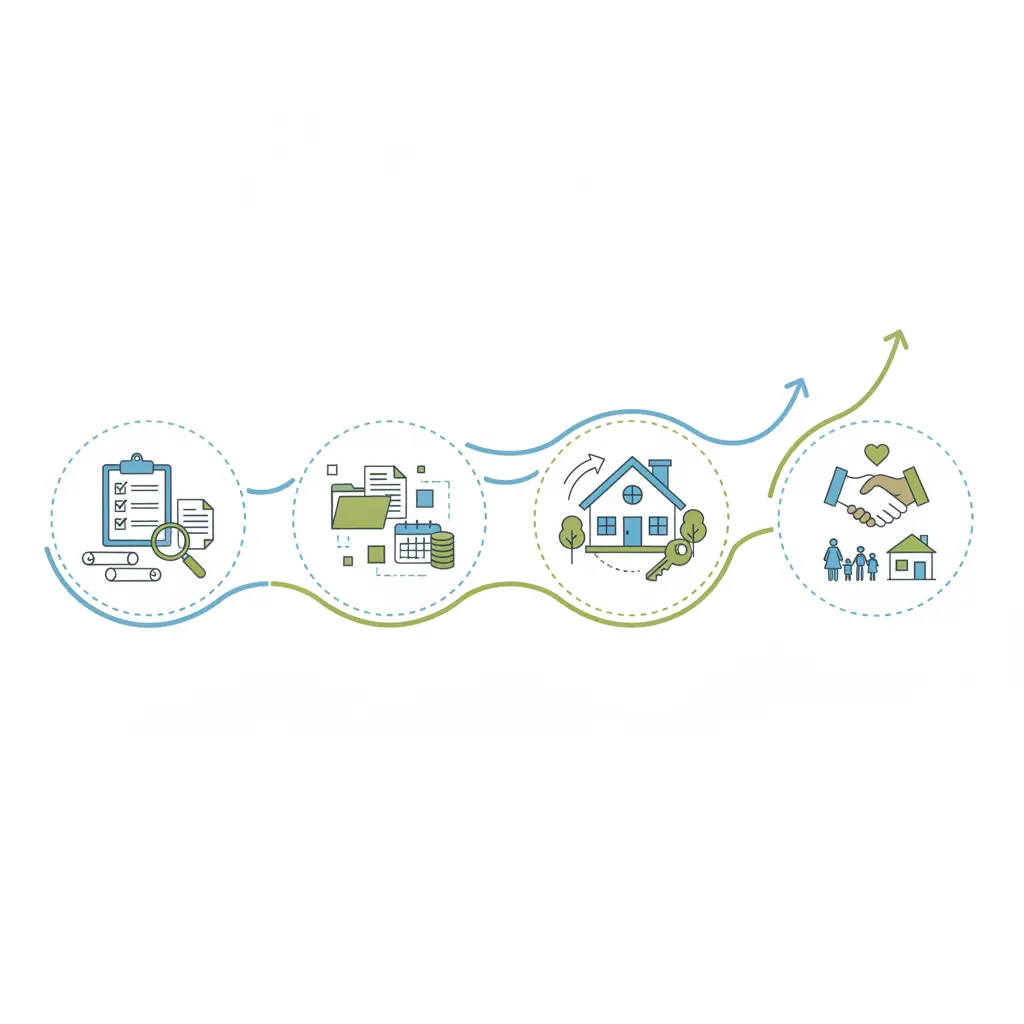
Phase One
Intake
Before anyone runs your credit or submits an application, a good loan originator (and a prepared borrower) needs to gather the right information. The intake phase is like filling in the blanks before starting a puzzle — it helps everyone figure out which programs you might qualify for, and it prevents surprises later. Think of this as your prep work.
Most DPA programs don't just look at your income — they look at your whole household. That means everyone who will live in the home may be counted, even if they're not co-signing the mortgage.
Be ready to share the following for every person age 18 or older who will live in the home:
- Full legal name and relationship to the borrower
- Gross monthly income (before taxes) from all sources — jobs, self-employment, Social Security, child support, etc.
- Employment status (full-time, part-time, seasonal, self-employed)
- Whether they have owned a home in the last 3 years
You'll also want to collect:
- Social Security numbers for all borrowers
- Two years of W-2s or tax returns
- Recent pay stubs (last 30 days)
- Bank statements (last 2–3 months)
Down Payment Assistance comes in several forms. Before you get excited about a program, understand what you're actually getting — because the structure affects what you'll owe after closing.
| Type | What it means | Do you have to pay it back? |
|---|---|---|
| Grant | Free money — no strings attached once you close. | No |
| Forgivable Loan | A loan that disappears over time (usually 3–10 years) as long as you stay in the home. | Only if you sell or move out early |
| Deferred Loan | No monthly payments, but you repay it when you sell, refinance, or pay off the home. | Yes — later |
| Second Mortgage | A regular loan with a monthly payment added on top of your first mortgage. | Yes — monthly |
DPA programs also come in two structural forms:
- Separate 2nd mortgage: Your regular lender handles your first mortgage, and the DPA funds come as a separate second loan from a city, county, or state program.
- Combined assistance loan: One lender handles both the first mortgage and the DPA in one package. Easier to manage, but fewer options for customization.
The separate 2nd mortgage can often provide a larger dollar amount and give you more flexibility. Combined loans are simpler but may have fewer program options.
This is one of the most important things to understand about DPA, and it surprises a lot of people: your DPA income limit is NOT the same as your mortgage income.
Two ways programs calculate income:
1. Household Income (used by most Bond programs)
All adults age 18+ who will live in the home are counted — even if they're not on the mortgage. This is their gross monthly income from all sources. If your adult child lives with you, their income counts.
2. Credit Qualifying Income (used by most TBA programs)
Only the borrower(s) on the mortgage application count. Non-borrowing household members' income is ignored for the income limit check.
| Program Type | Whose Income Counts? | Common Examples (Florida) |
|---|---|---|
| Bond Programs | All household members age 18+ | Florida Hometown Heroes Bond, Florida First Bond |
| TBA Programs | Borrower(s) on the loan only | Florida Hometown Heroes TBA, Florida First TBA |
Also note: mortgage income calculations average variable income (overtime, bonuses, commission, tips) over two years. DPA programs may count that differently. Always confirm.
Every DPA program layers additional requirements on top of your regular mortgage. Think of it as two sets of rules — you have to pass both.
Credit Score
The DPA program's minimum credit score may be higher than what your mortgage requires. For example, you might qualify for an FHA loan with a 580 score, but the DPA on top may require 620 or 640. Know your number before you search for programs.
First-Time Homebuyer Status
Many programs require that you have not owned a home in the last 3 years to be considered a "first-time" buyer. But some programs waive this for veterans, buyers in certain areas, or specific workforce groups. Don't count yourself out without checking.
Property Eligibility
- Most DPA programs cover single-family homes, condos, and townhomes — but not investment properties or vacation homes.
- Some programs exclude 2–4 unit properties.
- New construction is sometimes allowed but may have extra conditions.
- Geographic restrictions are common — programs may only apply in specific counties, zip codes, or census tracts.
- Purchase price caps apply — confirm the program's maximum sales price matches your target budget.
DTI (Debt-to-Income) Ratio
DPA programs often have their own DTI caps. Even if your mortgage lender allows a 50% back-end DTI, the DPA program may cap it at 45%. If the DPA has a monthly payment, that payment must also be included in your DTI calculation — which can affect how much home you can afford.
Liquid Assets
Some programs have limits on how much cash you're allowed to have in the bank (retirement funds are usually excluded). If you have significant savings, check whether the program counts that as a reason to disqualify you from "need-based" assistance.
Phase Two
The DPC Walkthrough
Once intake is done and you have a clear picture of your household, it's time to move through the actual process. DPC stands for Down Payment Connect — the professional platform loan originators use to find and verify DPA programs across the country. The steps below walk you through what happens from program search all the way to closing day.
Down Payment Resource — Free and public-facing. Homebuyers, loan officers, and real estate agents can use it to explore available programs. Great for a first look.
Down Payment Connect (DPC) — A paid professional tool used by loan originators. It has access to nearly every DPA program in the country, with full program details, eligibility tools, and documentation requirements. This is what your loan officer uses on the back end.
Your loan originator uses the DPC platform to search programs available in your target county and filter them by what you actually qualify for. This step happens before any formal application — it's a research and screening step.
What's being filtered at this stage:
- Income limit vs. your household income (using the right calculation method for each program)
- Your credit score vs. each program's minimum
- Property type (single-family, condo, etc.) and location eligibility
- First-time homebuyer requirement (if applicable)
- Maximum purchase price vs. your target price range
- Whether the program is currently funded (funds run out — this matters)
After filtering, you should end up with 2–3 realistic programs to evaluate in detail. More than that can get overwhelming; fewer than two doesn't give you a backup if one falls through.

Once programs are identified, the loan originator pulls your credit and runs Automated Underwriting System (AUS) findings using the first mortgage product that pairs with each DPA program. This confirms you actually qualify — not just in theory, but in the system that approves loans.
At this stage, your originator will:
- Verify your income meets the DPA program's limit using the correct calculation method
- Confirm your credit score clears the DPA program's threshold (separate from the mortgage minimum)
- Verify the target property address is in an eligible area
- Check that the sales price is within the program cap
- Calculate your DTI ratio — including the DPA payment if it has a monthly payment
- Document all eligibility verification in writing before issuing a pre-approval letter
Most DPA programs work on a first-come, first-served basis. Funds are allocated as reservations come in, and when they're gone, they're gone — until new funding is approved. This means the moment you're ready to make an offer on a home, your originator should simultaneously:
- Submit your mortgage application
- Reserve or apply for the DPA funds with the program administrator
What you'll need to have ready for the DPA reservation:
- Completed 1003 mortgage application
- Income documentation (pay stubs, W-2s, tax returns)
- Credit report (pulled by your originator)
- Property address (even a preliminary address if you're still under contract)
The reservation puts a "hold" on the funds for you while the rest of the process plays out. Your originator manages the reservation deadlines — but you need to know they exist so you don't cause unnecessary delays.
Nearly every DPA program requires at least one borrower to complete a HUD-approved Homebuyer Education course before funds are released. Some programs require all borrowers. A few programs even require the loan originator and/or the real estate agent to complete training before they can work with that program's clients.
Start this as early as possible. It is one of the most common reasons DPA transactions get delayed. By the time you have a signed contract and a closing date, you may not have time to get enrolled and complete the course before the program's deadline.
What to know about homebuyer education:
- Courses are typically 6–8 hours total
- Many programs accept online courses (Framework, eHome America, others)
- Some programs require in-person or phone-based counseling — especially if there are credit challenges
- Verify the specific format your program accepts before enrolling
- You'll receive a certificate of completion that becomes part of your DPA file
- The certificate may have an expiration date — don't complete it too far in advance
A DPA transaction has two parallel approval tracks:
Track 1: Your First Mortgage
This goes through standard mortgage underwriting — Fannie Mae, Freddie Mac, FHA, USDA, or VA depending on your loan type. The underwriter reviews your income, credit, assets, and the property appraisal.
Track 2: The DPA Program
The DPA program has its own underwriting and approval process. This is separate from your first mortgage lender and is handled by the program administrator. They review compliance with their program guidelines, income limits, homebuyer education completion, and property eligibility.
Your DPA file package typically includes:
- A copy of your 1003 mortgage application
- Income documentation (W-2s, pay stubs, tax returns)
- Homebuyer education certificate
- A signed and executed purchase contract
- A commitment letter from your first mortgage lender
Your loan originator should proactively manage both pipelines and keep you and your real estate agent updated. If you're not hearing status updates from both tracks, ask.
Closing with DPA requires additional coordination that a standard transaction doesn't. Your originator should handle this, but you should know what's involved so you can ask the right questions.
Before Closing Day
- The DPA program administrator must confirm how funds will be disbursed — wire transfer, check, or direct payment to the title company
- The closing agent (title company) must receive the DPA commitment letter and any special closing instructions from the program
- Your Closing Disclosure (CD) must correctly show the DPA funds — review it carefully
- Confirm your homebuyer education certificate is in the file before the closing date
At Closing
You'll sign documents for both your first mortgage and the DPA second lien. The DPA funds reduce your out-of-pocket costs at the closing table. Make sure you understand exactly what you're signing — especially the terms of the DPA loan, including any forgiveness schedule and what triggers repayment.
After Closing
- Live in the home as your primary residence for a set period
- Submit annual owner-occupancy certifications to the program
- Notify the program before refinancing (subordination rules may apply)
- Repay the balance if you sell before the forgiveness period ends
Ask your originator to walk you through the post-closing obligations specific to your program before you sign — not after.